
me and you: we
An essay by Marco Forni on the work of Roland Perathoner — on dialogue, on wood, and on the empty lap of the seated figures.
From the catalogue “Roland Perathoner — Scultore Bildhauer Sculptor”, 2026 · Reproduced with the author’s permission
We inherit and carry within us – already since our birth – fragments of the lives of others who inhabited this earth before us.
Who do we need? Ourselves, of course, but also the others. It is thanks to them that we get to know ourselves better; as a result, we are no longer content to merely use up our time on this earth.
Our being and our life hardly take shape in solitude. We continuously develop our abilities, our consciousness and our knowledge by interacting with those who live around us. We eat food prepared by others, wear clothes made by others and inhabit houses built thanks to the work of others. Much of what we know and what we believe in was taught to us by others, in a language created by others, as Albert Einstein once wrote, summing it up in a nutshell.
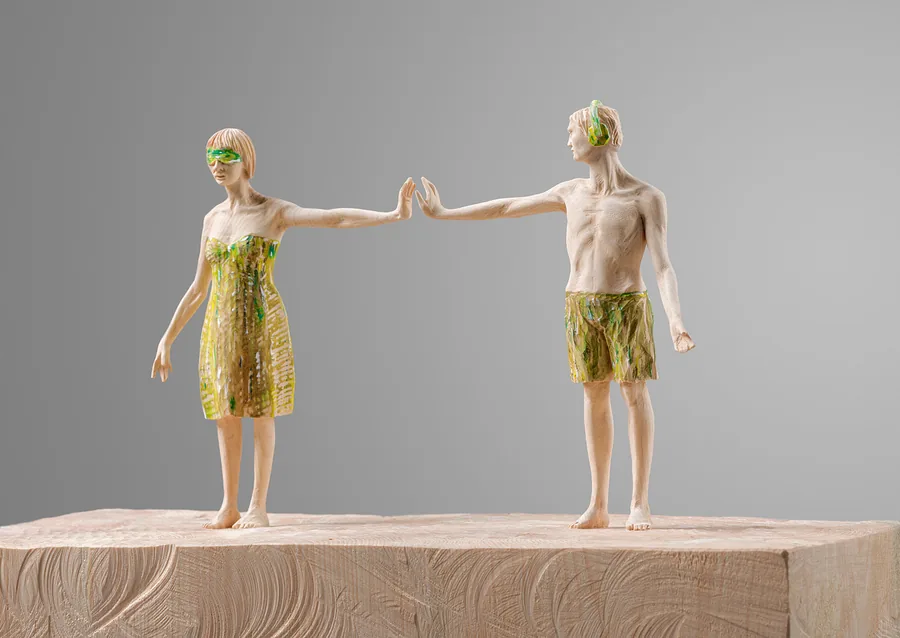
A dialogue is a conversation between two or more people. We can get in touch with someone, but also with ourselves, with our thoughts and needs.
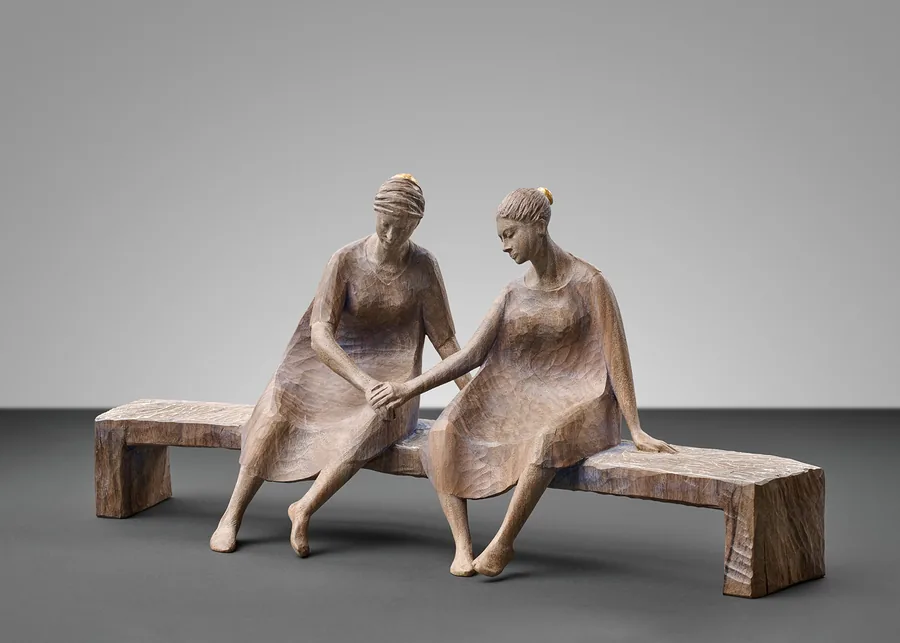
In his artworks, Roland depicts a dialogue that has been misheard, omitted or hoped for. It usually takes place between two people; the third person is the one who stops for a moment and looks at his works in walnut wood or pinewood. Walnut wood is elegant, pinewood is a native material and smells of our homeland, where Roland feels he has his roots.
A dialogue is also a musical composition for two voices. In a dialogue, a certain harmony or, on the contrary, a dissonance can arise, just as in music.
Musicians, instrument players, are carved in wood by Roland as well. Only when an instrument is being played, it comes alive. Otherwise, it remains lying on the shelf, like a tool that is not used in a functionally correct way.
It is common to say: “This carver is really talented”. But not everyone is satisfied with an adulation like this; over time, we settle into a certain routine, which brings with it a certain degree of security. And yet we cannot escape that veil of unease that gradually drives in like a blunted woodcarving knife that cannot carve properly, because it does not match with what we feel inside.
Roland, too, has felt the need to distance himself from the learned certainty to finish a certain artwork. He has begun to let go, to clean up, in order to create more essential forms and to devote himself to his inner world, to free himself from his outer protection, which everyone sees without looking at it more closely. This stands out especially in his more stylised works in walnut wood. The figures in pinewood take on more realistic features. Sometimes there are single spots of colour that evoke a hint of a feeling, a reaction that cannot be put into words with the fixed expressions of our linguistic repertoire. Roland gives shape to his ideas in clay first, since this material can be constantly changed and transformed into another shape. In this way, the artwork can adjust, to some extent, to the need that comes from within. When carving in wood, you are more bound; once you work on it, it takes on certain features, a form that can no longer be changed visibly.
Sometimes we begin a piece of work, but we can get stuck with it: it seems impossible to finish it; that‘s why we put it aside and we can take it up again later – if we want so – when the time is ripe, one day, whenever that may be.
The small figures made of walnut wood – almost as if they didn’t want to get in the way – are represented in a sitting position and often have an empty lap – like the apse of a church, whose shape recalls an embrace that we sometimes forget to give. A carved-out lap that silently invites us to get closer to each other and to give birth to another opportunity to meet and listen to each other.
Sometimes we are physically close, but very far away with our thoughts. We hide behind empty words, which we can also whisper to each other through our mobile phones, thinking erroneously that we are always connected to the whole world; in order not to get in touch with ourselves, with our inner voice.
The situations depicted – everyday scenes of two people like us – call us back to our loneliness after we probably had to cope with an everyday worry.
Roland illustrates a sequence, a situation in which we struggle to get in touch with the other. However, he does not point his finger at this unspoken discomfort or does not judge it deliberately. Rather, he invites us to think about it in silence. Everyone should have the freedom to think about it and to form his own opinion.
Sometimes a single word would be enough to open a dialogue. But the right words are not easy to find and the misunderstandings constantly increase, so that we move further and further apart from each other and feel powerless.
In our everyday lives, we can benefit from a universal rule. We should never stop asking ourselves questions in order to acquire a different point of view and forget the answers we already think to know. This way, we can keep searching and give shape to an idea, a thought, a feeling or an emotion; but also to our inner drive and creativity: we must connect with the others in order to get to know ourselves better again and again.
Marco Forni
The catalogue’s introduction
The story of life unfolds through the work of Roland Perathoner, a sculptor who works both wood and bronze, to create his symbolic figures.
His aim is not simply to carve or forge them, but to tell the story of one or more situations. This is how his musicians or his seated figures appear, serenely absorbed in contemplating the world.
These artworks are mostly small and stand out against abstract backgrounds, as if they were theatre comedians about to celebrate the continuous rhythm of existence.
Introduction to the catalogue “Roland Perathoner — Scultore Bildhauer Sculptor”, 2026
Who wrote this text?
Marco Forni, a linguist and lexicographer of Gardenese Ladin at the Istitut Ladin “Micurà de Rü”. He wrote the essay “me and you: we” for Roland Perathoner’s printed catalogue. It is reproduced here with his permission.
What is the essay about?
About dialogue as the subject of the work: two figures who mean one another and yet talk past each other. Forni writes about walnut, which is elegant, and Swiss stone pine, which smells of home; about the road from the changeable clay model into wood that does not forgive; and about the empty lap of the seated figures, which recalls an embrace we sometimes forget to give.
Where was the text first published?
In the catalogue “Roland Perathoner — Scultore Bildhauer Sculptor” of 2026, supported by the Autonomous Province of Bolzano – South Tyrol, Ladin Culture. The catalogue is in four languages: Ladin, German, Italian and English. Design: Benno Perathoner, printing: Typak.
A visit to the studio?
Just call.
Via Col da Lech 20I-39048 Selva di Val Gardena (BZ), Italy
+39 333 720 28 28
roland.perathoner@gmail.com
Visits by appointment
Getting here
The workshop is in Selva di Val Gardena (Wolkenstein), on Str. Col da Lech above the village centre. Coming along the Val Gardena road SS242, turn uphill to the right in the village; from Bolzano it is about forty minutes by way of Ponte Gardena and Ortisei, about twenty from the Gardena Pass. Without a car: bus 350 stops in the centre, and it is a ten-minute walk uphill from there. There is parking in front of the house.